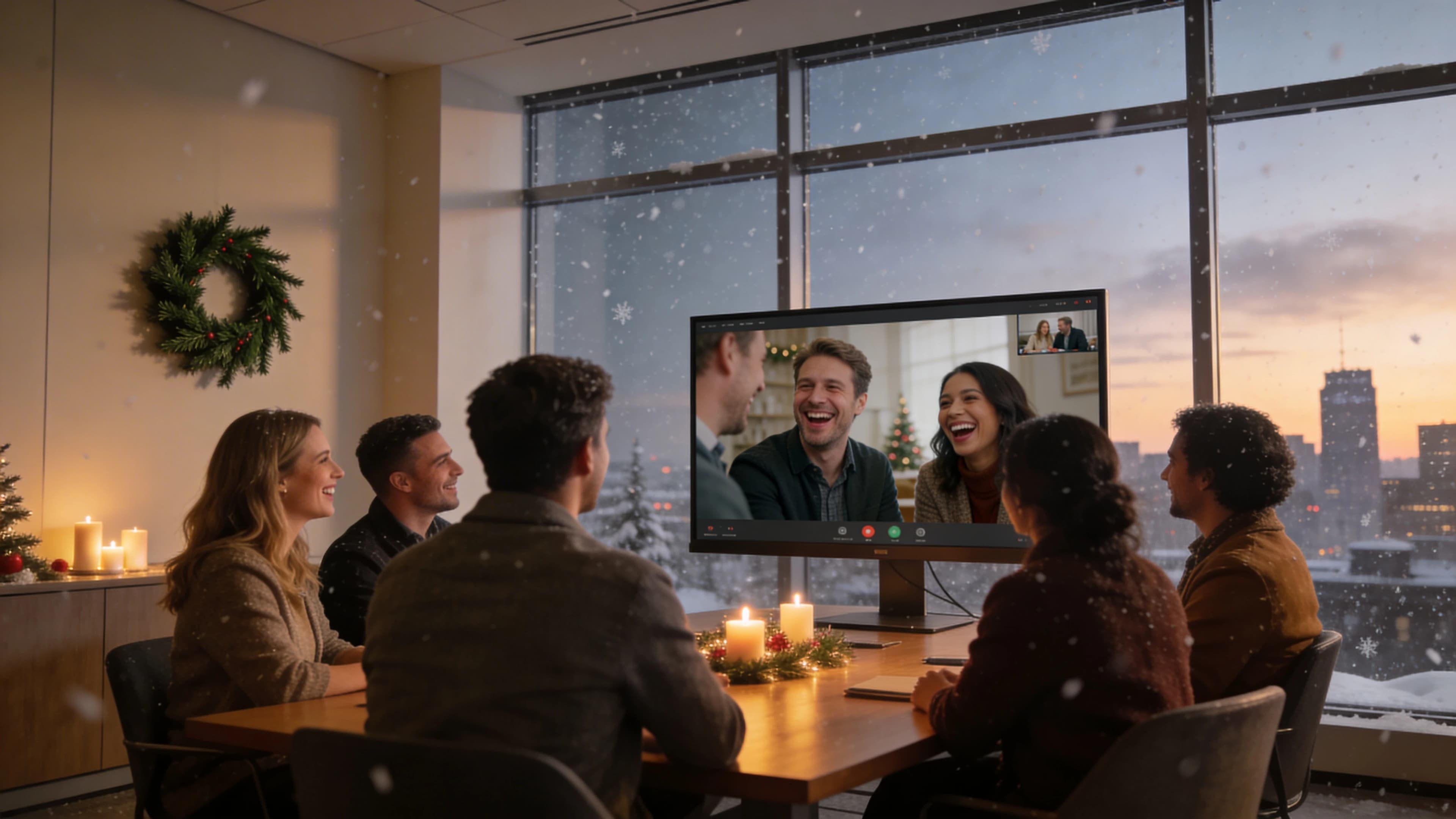
The Holiday Video Assignment Just Landed on Your Desk
It is late November. Someone in leadership had a moment of inspiration over their morning coffee and decided the company needs a holiday video. A "fun one." For the team. And now, somehow, it is your problem.
You already know the stakes. A bad corporate holiday video is worse than no video at all. It gets screenshotted, dissected in group chats, and remembered for years. Internet Brands (the company behind WebMD) learned this when their return-to-office video drew reactions like "this is such corporate cringe I'm having trouble accepting it's not satire" (HRD America). That is the nightmare scenario. Nobody wants to be the person who greenlit that.
This article is not a list of 10 generic company holiday video ideas. Instead, it is a framework for understanding why most corporate holiday videos fail, what separates the ones people actually watch, and how to produce something good on a realistic budget and timeline. AI video tools like yume have made it possible to produce polished holiday videos in under 15 minutes for less than $30, so budget and timeline are no longer valid excuses. The bar for what counts as "good enough" has moved.
Why Most Corporate Holiday Videos Get Skipped in Seconds
91% of businesses now use video as a marketing tool, and over 75% of employees prefer watching a video to reading text. The medium works. The execution is where things fall apart.
Three mistakes kill nearly every corporate holiday video. Diagnose these first.
Mistake 1: They Are Way Too Long
Average video length has shrunk from 168 seconds to 76 seconds since 2016 (Shno). Videos under one minute get a 65% completion rate. Videos over 20 minutes? That drops to 20%. And 71% of people believe videos between 30 seconds and 2 minutes are the most effective length.
The typical corporate holiday video runs three to five minutes. That is two to four minutes longer than what the audience will tolerate. For a deeper look at platform-specific length recommendations, see The Optimal Video Length for Every Platform in 2026.
Mistake 2: They Could Have Come from Any Company in Any Year
Think about why Spotify Wrapped works. Over 200 million users engaged with it in the first 24 hours in 2025. Users shared their recap more than 500 million times, a 41% increase year over year. The reason is obvious: the content is specific and personal. It is your data, your name, your listening habits.
Now think about the typical corporate holiday video. Generic "happy holidays from our team" text over stock footage of snowflakes. It could have come from literally any company, in any year since 2008.
The WestJet "Christmas Miracle" succeeded precisely because it went the other direction. Real passengers. Personalized gifts. Genuine surprise on camera. It aimed for 200,000 views and hit 27 million in one week, driving an 86% increase in sales. Specificity is what makes something shareable. Generic is what makes something forgettable.
Mistake 3: All Logo, No Faces
89% of consumers say video quality impacts their trust in a brand. But "quality" here does not mean expensive production. It means authenticity.
Peloton learned this the hard way in 2019. Their holiday ad featured a woman receiving an exercise bike from her husband and documenting herself using it for a year. The production quality was flawless. The human connection was nonexistent. The backlash was severe enough to wipe $1.5 billion off their market value in three days (Fortune).
Meanwhile, only 26% of employees strongly agree they receive adequate recognition at work. Employees who do feel recognized are 4x as likely to be engaged. A holiday video featuring real team members, by name, is an act of recognition. A video with just a logo and a stock photo montage is not.
The Three Principles of a Corporate Holiday Video People Will Actually Watch
These principles work regardless of your format, budget, or team size. Use them as a filter for whatever approach you choose.
Principle 1: Specificity Over Sentiment
Reference actual events, people, and milestones from the year. Not "it's been a great year" but "we launched the Berlin office, welcomed 40 new people, and shipped V3 of the product."
Think of it as the Spotify Wrapped formula applied to your company. What would your organization's "Wrapped" look like? Your top wins. Your biggest team. The project that almost didn't make it. The person who stayed late to fix the thing before the launch.
A 30-second video referencing one specific moment from the year will outperform a three-minute video full of generic warm wishes. Every time.
Principle 2: Brevity Is Respect
Target 30 to 90 seconds. Absolute maximum: two minutes.
The data is clear. 65% completion for videos under one minute, sharp dropoff after that. A video is generally considered successful at 60%+ completion. If you cannot say it in 90 seconds, you are saying too much.
Cut the CEO monologue. Cut the department-by-department roll call. Get in, make people feel something, get out. Respecting someone's time is itself a form of respect. For tips on nailing the opening seconds, check out How to Write Video Ad Hooks That Stop the Scroll.
Principle 3: Show Faces, Not Logos
Feature real people from the company. Names, faces, candid moments. When only 26% of employees feel adequately recognized, a holiday video that features real team members sends a powerful signal.
This does not require a film crew anymore. Character consistency in AI video tools now makes it possible to feature team members in cinematic scenes using just reference photos, without scheduling a shoot or renting a studio. Upload a few photos of your team, and the AI maintains consistent likenesses across every shot.
This principle applies to leadership messages too. A CEO's face on camera connects more than a voiceover layered over an animated logo. Even if the visuals are AI-generated, the presence of a real human face changes how people engage with the content.
Five Corporate Holiday Video Formats That Actually Work
These five formats consistently score well on the three principles above. Pick the one that fits your company culture, timeline, and available material.
1. The Year-in-Review (Best for Most Companies)
A 60-to-90-second highlight reel of the company's year. Milestones, wins, new hires, product launches, team moments. Maximum specificity. This video can only come from your company, this year.
The hardest part is usually gathering the footage and editing it together. AI tools collapse this process significantly. With yume, you describe your year in a chat conversation, reference the highlights, upload team photos, and receive a finished video with voiceover and music in minutes. No editing skills, no storyboard, no production timeline.
2. The Team Thank-You
A short video recognizing specific teams or individuals. This one names names. "Thank you to the engineering team for the late nights before the October launch." "Sarah, the deal you closed in Q3 changed the trajectory of the company."
It directly addresses the recognition gap. Employees who feel recognized are 4x more engaged. Keep it under 60 seconds. One genuine, specific acknowledgment per team or person.
3. The Blooper Reel / Behind-the-Scenes
A compilation of funny or candid moments from the year. Outtakes from all-hands meetings, office mishaps, event fails. All faces, no corporate polish. People watch it because it is genuinely entertaining.
The caveat: this requires a culture where people are comfortable being silly on camera. It also requires having collected footage throughout the year. If you are reading this in late November and have no footage, this one is probably not your format for this year. Start collecting clips in January.
4. The Leadership Message (Done Right)
A 30-to-60-second message from the CEO or founder. Most of these fail because they are a four-minute teleprompter reading filled with corporate platitudes. The fix is straightforward: specific acknowledgments (not "great year, team"), a personal tone, and a hard cap at 60 seconds.
AI video tools offer an interesting option here. Cinematic visuals paired with a natural-sounding voiceover can eliminate the stiffness that comes from a leader reading from a script on camera. The chat interface lets you iterate on tone until it sounds right, which is often faster than doing multiple takes in a conference room.
5. The Client/Customer Appreciation Video
A holiday greeting directed outward, to clients and customers. This stands out from the avalanche of email greetings landing in inboxes every December. Corporate videos get 60% more engagement than written updates, and a video greeting is far more memorable than a paragraph of text.
For companies with international clients, multilingual support matters here. Producing the same concept in English, Spanish, French, and Mandarin without starting over saves significant time. Yume supports 23 languages for voiceover output, so a single concept can serve your entire client base.
Format Comparison
| Format | Specificity | Brevity | Real Faces | Difficulty | Best For |
|---|---|---|---|---|---|
| Year-in-Review | High | Medium (60-90s) | Medium | Medium | Most companies |
| Team Thank-You | High | High (under 60s) | High | Low | Recognition-focused cultures |
| Blooper Reel | Medium | Medium | High | High (need footage) | Casual company cultures |
| Leadership Message | Medium | High (30-60s) | High | Low | CEO-driven organizations |
| Client Appreciation | Medium | High (30-45s) | Medium | Low | Client-facing businesses |
The Budget and Timeline Reality
The holiday video assignment typically arrives in late November with a mid-December deadline. That is a two-to-three-week window. Traditional production takes four to eight weeks. The math does not work.
Here is an honest comparison of your three production paths.
| Factor | AI Video (yume) | DIY (iPhone + iMovie) | Professional Agency |
|---|---|---|---|
| Cost | EUR 15-30 one-time (templates) or EUR 30/month (chat) | Free (but significant time cost) | $2,500-$25,000 per project |
| Timeline | 5-15 minutes (templates); single session (chat) | 2-5 days of evenings and weekends | 4-8 weeks |
| Quality | Cinematic (shot types, camera angles, color grading, voiceover, music) | Amateur (shaky footage, poor audio) | Professional (custom everything) |
| Editing Skills | None (chat interface) | Basic (iMovie/CapCut) | None (agency handles it) |
| Multilingual | 23 languages from one concept | Record separately per language | Reshoot or re-edit per language |
| Character Consistency | Yes (reference photos) | Yes (real footage) | Yes (real footage) |
| Revisions | 15 free shot edits included | Unlimited (but time-consuming) | 1-3 rounds typically included |
The Cost-Per-Employee Math
For a 500-person company, traditional production at $2,500 to $7,000 equals $5 to $14 per employee reached, assuming everyone watches. Factor in the 65% completion rate benchmark for videos under one minute, and the effective cost per engaged employee rises to $7.70 to $21.50.
With yume at EUR 29 for a template, the same 500-person company pays EUR 0.06 per employee. At 65% completion: EUR 0.09 per engaged employee. That is roughly an 85x to 240x cost reduction, depending on which end of the traditional pricing range you compare against.
42% of video marketers already spend $0 to $500 on average per video. AI tools now make that budget sufficient for cinematic quality. For more on this shift, see The End of the Agency Retainer: How Marketers Produce High-End B2B Video.
When Professional Production Still Makes Sense
Not every situation calls for AI. Hire a production company when:
- You are a household-name brand creating a public-facing campaign (John Lewis, WestJet scale)
- The video requires real live-action footage of specific events or locations
- The content will run as paid media with significant ad spend behind it
For internal-facing holiday videos, which is the vast majority of corporate holiday content, traditional production has become hard to justify on cost and timeline alone.
How to Measure If Your Corporate Holiday Video Actually Worked
You made the video. You sent it. Now what? No existing guide on corporate holiday videos covers measurement, which is strange, because it is the only way to know if you should do this again next year.
Quantitative Metrics
Completion rate. 60%+ is the success benchmark. If your video is under 90 seconds and clears this threshold, it worked.
View count vs. employee count. Simple division. What percentage of your company actually watched it?
Internal share rate. How many people forwarded it in Slack, Teams, or email without being asked? Organic sharing is a stronger signal than views.
If you are distributing the video externally as well, Video SEO: How to Get Your Videos Found on Google and YouTube covers discoverability strategies.
Qualitative Signals
The "reply-all compliment" test. If multiple people respond to the distribution email with a genuine comment (not just "nice!"), that is a strong signal.
People quoting specific moments from the video in conversation over the following week. If someone mentions a scene from your holiday video at the water cooler or in Slack, you hit the mark.
Requests to do it again next year. That is the ultimate success signal. It means people remember it and want more.
Quick Checklist Before You Hit Send
- Is it under 90 seconds? If not, cut it.
- Does it reference at least one specific moment, person, or achievement from this year?
- Are there real human faces in the first five seconds?
- Could this video have been made by any company, or is it clearly yours?
- Have you watched it with the sound off? Does it still make sense visually?
- Have you tested it on one honest colleague who will tell you if it is cringe?
- Is the distribution plan in place? (Email, Slack, intranet, social media)
- Do you have the right format for each platform? (16:9 for email and LinkedIn, 9:16 for Stories and Reels, 1:1 for feeds)
If you want to see what a cinematic holiday video looks like without the production timeline or budget, describe your company's year at yume.video. You will have a finished draft in about 10 minutes.
Frequently Asked Questions
How long should a corporate holiday video be? 30 to 90 seconds. Videos under one minute achieve a 65% completion rate, and 71% of people believe 30 seconds to 2 minutes is the most effective range. If your holiday video runs longer than two minutes, most of your audience is gone.
What should you say in a company holiday video? Reference specific achievements, milestones, and people from the past year. "We launched our London office, welcomed 40 new team members, shipped the redesign in September." That kind of detail will always outperform a generic "happy holidays from all of us" message. Keep it warm but concrete.
How much does it cost to produce a corporate holiday video? Traditional video production runs $2,500 to $25,000 per project and takes 4 to 8 weeks. AI video tools produce cinematic-quality videos with voiceover and music for EUR 15 to 30 in under 15 minutes. For most internal-facing holiday videos, AI delivers comparable quality at a fraction of the cost.
How do you make a company holiday video without a production team? AI video platforms handle the entire process. You describe what you want in plain language, and the AI generates visuals, voiceover, music, and motion design. No editing skills, camera equipment, or crew needed. The output includes proper shot composition, camera angles, and color grading.
What are good holiday video ideas for employees? Five formats consistently work: a year-in-review of company milestones, a team thank-you naming specific people, a behind-the-scenes blooper reel, a brief leadership message under 60 seconds, and a client appreciation video. Choose based on your company culture and what material you have available.
Do corporate holiday videos actually improve employee engagement? When done well, yes. Corporate videos get 60% more engagement than written updates, and employees who feel recognized are 4x as likely to be engaged. The key is authenticity and specificity. A generic video can actually hurt engagement by signaling that leadership did not put real thought into it.
Can I make a corporate holiday video in multiple languages for global teams? Yes. AI video tools with multilingual support produce the same concept in multiple languages without separate production runs. yume supports 23 languages for voiceover, so a single holiday video concept can be delivered in English, Spanish, French, Mandarin, and others from one session.
References
- yume - AI video creation platform
- Wyzowl 2026 State of Video Marketing - Annual video marketing survey data
- Vidyard 2025 Video in Business Benchmark Report - Video completion and engagement benchmarks
- Gallup Workplace Employee Engagement - Employee recognition and engagement research
- Workhuman: Gallup Recognition Research - Recognition-engagement data
- DemandSage Video Marketing Statistics - Video spending and ROI data
- VMG Studios Production Timelines - Traditional production timeline breakdown
- Clutch Video Production Pricing - Agency pricing data
- NoGood: Spotify Wrapped Marketing Strategy - Engagement and sharing statistics
- WestJet Blog: Christmas Miracle - Campaign results and viewership data
- CBS News: Peloton Ad Backlash - Market impact analysis
- HRD America: Corporate Cringe Video - Employee reactions to corporate video
- Passive Secrets: Workplace Communication Statistics - Video vs. text engagement data
- Shno: Short-Form Content Statistics - Video length trend data