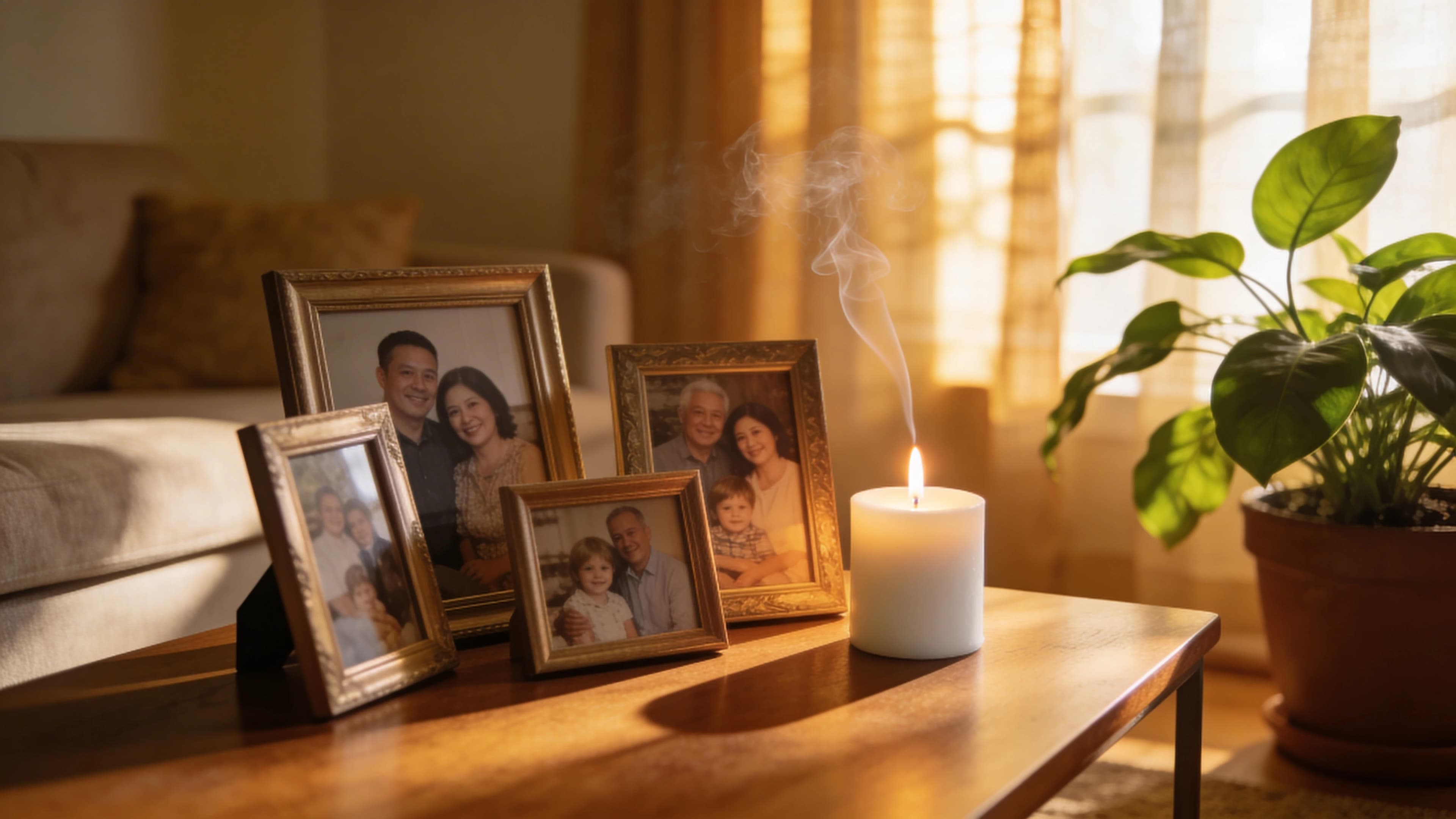
You Shouldn't Have to Learn Video Editing Software While Grieving
If you're reading this, someone you love has probably died. Maybe you're running on little sleep. Maybe you're coordinating flowers, writing an obituary, fielding calls from relatives. And at some point, someone asked: "Are we doing a slideshow?"
A celebration of life video is one of the most meaningful things you can bring to a service. 70% of families now prefer personalized celebrations of life over formal, traditional services. The problem is that every guide on how to make one assumes you're a rational, functioning person ready to learn new software. Grief doesn't work that way. Research shows it causes measurable cognitive impairment: difficulty concentrating, memory lapses, impaired decision-making. The exact skills you need to arrange 80 photos on a timeline.
The goal here is not to make you a video editor. The goal is to honor someone you love, with as little demanded of you as possible right now. Tools like yume exist specifically for this: you describe the person, share some photos, and receive a finished cinematic video with narration and original music in minutes. But there are several paths, and I'll walk through all of them honestly.
What a Celebration of Life Video Actually Is (and What It Can Be)
Before choosing a tool, it helps to know what kind of video fits the occasion. The terms get used interchangeably, but they mean different things.
A funeral is a formal event where the deceased is present, usually happening within days. A memorial service is more flexible; the deceased is not present, and it can take place weeks or months later. A celebration of life is the most casual of the three: lighthearted, focused on happy memories and accomplishments rather than loss. With the cremation rate projected at 63.4% in 2025, celebrations of life are growing fast.
Your video's tone should match the event. A solemn funeral calls for a different feel than a backyard celebration of life where people are sharing stories and laughing.
The traditional format has been more or less the same for two decades: 60-80 photos, each displayed for 4-7 seconds, crossfade transitions, a meaningful song in the background, running 5-8 minutes total. It works. But it's also the only option most people know about.
The newer possibility is a cinematic memorial video where still photos come alive with motion, a narrated voiceover tells the person's story, and original music is composed to match the emotional arc. Not a slideshow. A short film about someone's life.
Three Ways to Structure a Memorial Video
Pick whichever feels right. There's no wrong answer.
Chronological. Birth through life stages. The most familiar structure. Works well when you have photos spanning decades and want to trace a life from beginning to end.
Thematic. Organized around who they were: their role as a parent, their career, their hobbies, their friendships. This works when someone had distinct passions that defined them, and you want the video to reflect that.
Legacy. Structured around how they affected other people. The most emotionally resonant approach, but also the hardest to construct manually because it requires weaving together stories, not just arranging photos. AI-narrated formats handle this more naturally since you describe the person's impact and the AI shapes the narrative around it.
How to Make a Celebration of Life Video, Step by Step
These steps work regardless of which tool you choose.
Step 1. Gather Photos (Without Drowning in Them)
The biggest trap here is trying to collect every photo that exists. Don't do that. Ask 2-3 close family members to each send their 10-15 favorites. That's it.
For a traditional slideshow, aim for 60-80 photos. For a cinematic AI-generated video, 5-20 strong photos is plenty because the AI creates motion and visual scenes from each image rather than just displaying them as static frames.
Try to cover different life stages: childhood, young adult, middle years, recent. Create a shared album on Google Photos or Apple Shared Albums so family members can drop photos in without coordinating back and forth.
Step 2. Choose a Structure
Refer to the three approaches above. Chronological is the default if you're unsure. Thematic if you know exactly what made them who they were. Legacy if you want to focus on the feeling they left behind in people's lives.
Don't overthink this. You can always reorder later.
Step 3. Write a Few Sentences About Who They Were
Even if you're making a slideshow with no narration, writing 3-5 sentences about the person helps you focus the video. What made them them? What do you want people to feel when they watch?
If you're using an AI tool that generates narration, these sentences become the input. You don't need a polished script. Speak from the heart. "Dad was a quiet man who showed love through fixing things. He could repair anything. He never said much but he was always there." That's enough.
Step 4. Pick Your Tool
This is where the decision gets practical. I've compared the major options below.
Step 5. Review and Edit
Watch the video once through without touching anything. Just watch. Note what feels right and what feels off.
Most tools allow you to adjust individual shots or sections. Change one thing at a time rather than starting over. And ask one other family member to watch it before the service. A second pair of eyes catches things you might miss, especially when you're grieving and your attention is scattered.
Step 6. Share It Beyond the Service
9 out of 10 funerals have loved ones who can't attend because of distance, illness, or other commitments. 53% of people want digital keepsakes like tribute videos. The video you make isn't just for the room. It's for everyone who cares.
Email it to family. Upload it to a private YouTube link. Post it in a memorial Facebook group. Just be aware of one thing: if you used a copyrighted song, platforms will flag or mute the video. This is a real problem, and I'll cover it in detail below.
Over the years, the video becomes less about grief and more about preservation. Families rewatch on anniversaries and birthdays. Grandchildren who never met the person get to know them through the video. It becomes oral history.
Memorial Video Maker Comparison: Cost, Speed, and What You Actually Get
The right tool depends on your budget, how soon the service is, and how much mental energy you have. Here's an honest comparison.
| yume | Animoto | Canva | Professional Editor | Memorial Video AI | |
|---|---|---|---|---|---|
| Cost | $15-$29 (one-time) | $9-$59/month | Free-$13/month | $500-$1,200+ | $35-$100 |
| Delivery time | 5-15 minutes | 4-12 hours (DIY) | 4-12 hours (DIY) | 2-7 days | ~1 hour |
| Cognitive load | Very low (describe the person, upload photos) | High (arrange photos, choose transitions, find music) | High (arrange photos, choose transitions, find music) | Low (but requires coordination) | Medium (upload photos, limited control) |
| Output type | Cinematic video with motion, narration, original music | Photo slideshow with stock music | Photo slideshow with stock music | Photo slideshow (professional quality) | Photo slideshow (PowerPoint format) |
| AI voiceover | Yes, 23 languages | No | No | No | No |
| Original music | Yes, composed to match video | Stock library | Stock library | Stock or licensed | Limited |
| Editing | 15 free shot edits (visuals, narration, music) | Re-edit manually | Re-edit manually | Revision fees | Unlimited revisions |
| Copyright safe for sharing | Yes (all audio is original) | Depends on music | Depends on music | Depends on music | Depends on music |
A few things worth noting. The median funeral cost is already $6,280-$9,995. Paying $500+ for a professional slideshow on top of that is a meaningful expense. At $15-$29, yume costs 94-97% less than professional services.
Animoto and Canva are solid tools if you have the time and energy to arrange photos, choose transitions, and find the right music. They produce good-looking slideshows. The tradeoff is the hours of hands-on work they require, which can be hard to summon while grieving.
If the service is in 48 hours and no one has started the video, delivery time becomes the deciding factor. Minutes versus days is the difference between having a video and not having one.
The Music Question: Copyright, Emotion, and What to Actually Use
This is something most guides gloss over, and it trips up a lot of families.
Many people default to the deceased's favorite song. Their wedding song, a song they always hummed, something that instantly brings them to mind. Emotionally, this is the right choice. Legally, it's complicated.
Playing a copyrighted song at the service itself is fine. Funeral home performance licenses cover music played at the event. The problem comes when you share the video afterward. YouTube, Facebook, and Instagram all use automated DMCA enforcement. Upload a video with a copyrighted song and it will likely be flagged, muted, or taken down.
This creates an uncomfortable choice: use a song that means something for one-time viewing at the service, or use generic stock music so the video can be shared freely and kept as a family keepsake.
AI-composed original music sidesteps the problem entirely. The music is unique to your video, composed to match its emotional arc, and fully owned by you. No copyright issues for sharing, rewatching, or passing down to grandchildren. yume generates original music this way. So does a small number of other AI tools. If shareability matters to you, this is worth considering.
Why Cinematic Memorial Videos Are Replacing DIY Slideshows
The photo slideshow format has been the standard for memorial videos for twenty years. The tools got easier to use, but the output stayed the same: static photos, crossfade transitions, background music. No narration. No motion. No story.
AI video tools have opened up a different category. A still photo of your grandmother at the beach can become a cinematic scene where the waves move, the light shifts, and a warm voice tells the story of her summers by the ocean. The photos aren't displayed; they're brought to life.
For someone who is grieving, the biggest advantage isn't the visual quality. It's the number of decisions that disappear. Instead of choosing transitions, timing photos to music, and hunting through stock audio libraries, you describe who the person was and the AI handles the rest.
yume works this way: a chat-based interface where you describe the person, upload 5-20 photos, and receive a cinematic video with voiceover and original music in 5-15 minutes. 15 free shot edits let you adjust anything that doesn't feel right. The voiceover supports 23 languages, so a multilingual family can have the narration in whatever language feels most authentic. A Chinese-American family might choose Mandarin for the grandparents. A Ukrainian family in Germany might choose Ukrainian.
If the phrase "I'm not tech-savvy" is running through your head: this is a chat. If you can send a text message, you can use it. There is no timeline to learn.
For more on how photo-based video creation works across different occasions, see our guide on the best apps to make a video gift from old photos. And if you want to understand what makes an emotionally resonant video narrative work, the principles in our piece on making a retirement video that actually moves people apply here too.
After the Service: Keeping the Video as a Family Keepsake
Most guides treat the memorial video as something you play at the service and forget about. That's not how families actually use them.
In early grief, the video gets watched frequently. It's a way to feel close to the person. Over time, the pattern shifts to intentional viewing on birthdays, anniversaries, and holidays. Years later, the video becomes something else entirely: oral history. Grandchildren who never met the person watch it to understand who they were. New partners and spouses watch it to know the family better. The relationship with the video changes, but the video stays.
This is why the quality of the video matters beyond the day of the service. A slideshow with stock music serves the moment. A cinematic, narrated video with original music serves the family for decades. It can be shared without copyright strikes. It tells a story that stands on its own without needing someone in the room to explain each photo.
Save the video in multiple places. Upload it to a private YouTube or Vimeo link for easy sharing. Keep a local copy on a hard drive. Send it to family members so no single person is the keeper.
If you're interested in creating a photo montage for a different occasion, our guide on making a photo montage with music covers the practical side.
Frequently Asked Questions
How many photos do I need for a celebration of life video? For a traditional slideshow running 5-8 minutes, aim for 60-80 photos displayed at 4-7 seconds each. For a cinematic AI-generated video, 5-20 strong photos is enough because the AI creates motion and visual scenes from each image rather than displaying them as static frames.
What music should I use for a memorial video? You have three options: a meaningful song (emotionally powerful but may cause copyright issues if shared online), royalty-free stock music (safe to share but often generic), or AI-composed original music (unique to your video, emotionally matched, and fully copyright-safe). If you plan to share the video beyond the service, AI-composed or royalty-free music is the safer choice.
How long should a celebration of life slideshow be? 5-8 minutes is the standard for in-service viewing. Long enough to feel meaningful without losing the audience's attention. If the video will primarily be shared online or watched privately, 2-3 minutes works for a tight narrative; up to 10 minutes if you have many moments to include.
What is the difference between a memorial video and a celebration of life video? A memorial video is a broad term for any video honoring someone who has passed. A celebration of life video specifically matches the lighter tone of a celebration of life event: focused on happy memories and accomplishments rather than loss. The same photos can work for either. The difference is in the narration, music, and overall mood.
Can I make a memorial video with just photos and no video clips? Yes. Most memorial videos are made entirely from photos. Traditional tools display them as static images with transitions. AI video platforms go further by adding cinematic motion to each photo, making still images feel alive. You don't need any video footage.
How much does it cost to have a memorial video made? Professional services charge $500-$1,200 for a slideshow and $950-$1,950+ for filmed and edited video. DIY tools like Animoto or Canva range from free (with watermarks) to $13-$59/month. AI video platforms like yume offer one-time pricing from $15-$29 with delivery in minutes.
References
- yume - AI video creation platform
- Animoto - Memorial slideshow maker
- Canva - Tribute video templates
- Memorial Video AI - AI-assisted memorial slideshows
- NFDA Statistics - Funeral industry cost data
- NFDA 2025 Cremation & Burial Report - Cremation rate projections
- NFDA Consumer Awareness Study - Family preferences for personalized services
- PMC: Grief and Cognition - Research on cognitive effects of grief
- Choice Mutual 2025 Survey - Consumer funeral preferences
- EventLive: Funeral Videographer Cost - Professional memorial video pricing
- TribuCast - Remote attendance statistics
- Funeral.com: Music Licensing - Copyright guidance for funeral videos
- Chptr Blog - Long-term memorial video usage