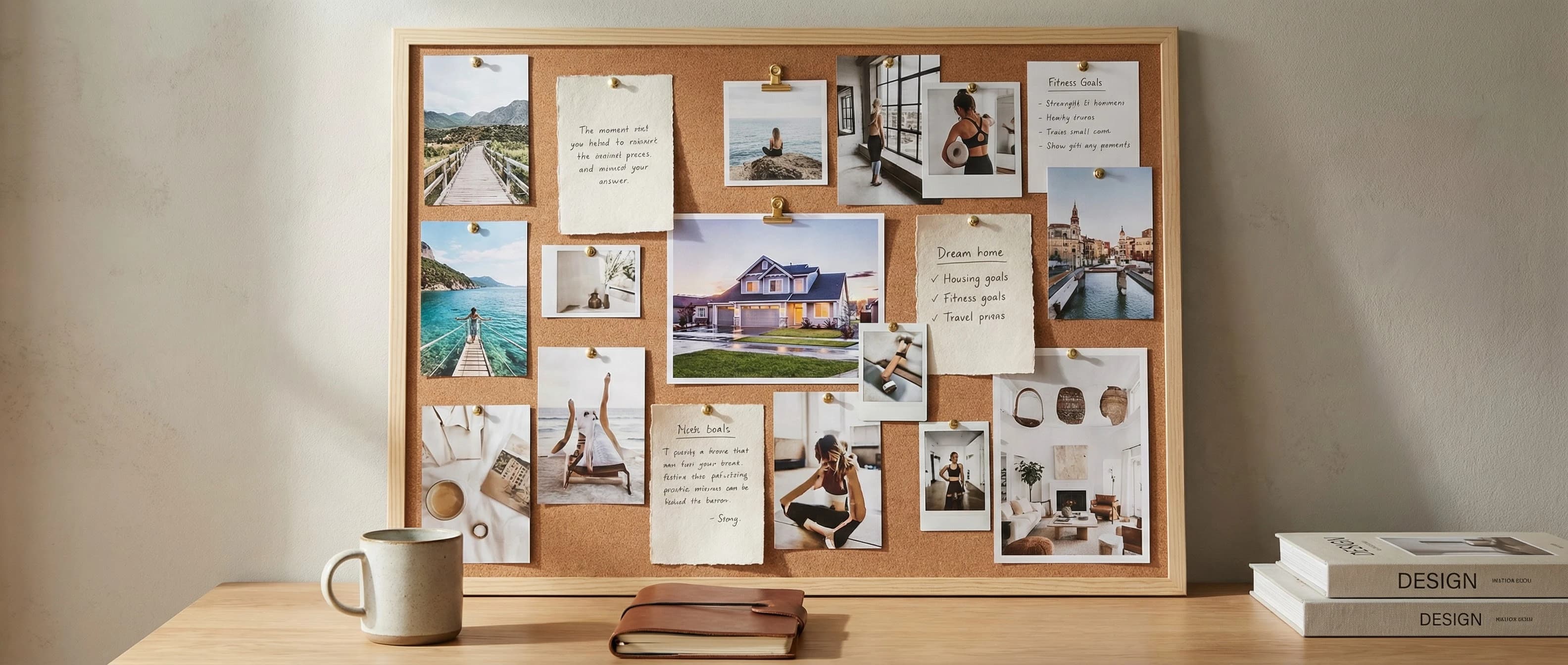
If you have ever made a vision board and watched it slowly become background wallpaper by March, you are not alone. 92% of people do not achieve their goals, according to University of Scranton research. 80% abandon New Year's resolutions by February. And the vision boards people made in January? They tend to follow the same trajectory.
The question of how to make a vision board that works is worth taking seriously, because the problem is not a lack of motivation. It is that the standard approach to vision boarding is designed around how we wish the brain worked, not how it actually works. Decades of research in cognitive psychology and neuroscience point to specific reasons why the magazine-cutout method falls flat, and to specific techniques that produce better outcomes.
This article covers the science, the practical fixes, and modern formats (digital, video, and AI-powered) that address each known failure point.
Why Most Vision Boards Stop Working After January
The most counterintuitive finding in motivation research might be this: positive fantasies about a desired future actually reduce your effort.
Psychologists Heather Barry Kappes and Gabriele Oettingen demonstrated this in a 2011 study published in the Journal of Experimental Social Psychology. Inducing positive fantasies about a desired future led to lower energy and lower effort, measured both subjectively and through objective physiological indicators like systolic blood pressure. The mechanism is straightforward: the brain gets a taste of the reward without doing any work, and the urgency to act fades.
The data across their studies is striking. Overweight women who fantasized most positively about losing weight lost 24 fewer pounds over a year. Positive job fantasies predicted fewer applications and lower-paying jobs over two years. Positive romantic fantasies predicted being less likely to pursue a relationship five months later.
Psychotherapist Amy Morin wrote in Inc. that she saw therapy clients whose vision boards "actually stunted their growth" because they were "waiting for the universe to grant their wishes" instead of taking action.
This points to six core reasons most vision boards fail:
- Outcome-only imagery creates premature satisfaction
- No action component turns the board into a passive wish
- No review cadence means it is forgotten within weeks
- Too many goals leads to a cluttered, unfocused board
- Hidden placement eliminates daily exposure
- Treated as magic instead of a psychological tool
The science of visualization is well established. The problem is that most vision board guides completely ignore it.
What Neuroscience Actually Says About Visualization
Process Visualization vs. Outcome Visualization
A 1999 study at UCLA by Pham and Taylor gave college freshmen one of two tasks before a midterm: mentally simulate the process of studying, or mentally simulate getting a good grade. The process group earned higher exam scores, started studying earlier, studied more hours, and felt less anxiety. The outcome group showed no improvement over the control group. In some cases, imagining the A actually reduced their motivation because they had already enjoyed the emotional payoff.
Michael Phelps, the most decorated Olympian with 28 medals, is perhaps the clearest example of process visualization in action. His coach Bob Bowman called their visualization sessions "mental videotapes." Every night before bed, Phelps would rehearse every stroke, every turn, and the finish from both first-person and third-person perspectives. He also visualized equipment failures and technical problems. At the 2008 Olympic 200m butterfly final, his goggles filled with water mid-race. Instead of panicking, he counted his strokes, a process he had rehearsed mentally hundreds of times, and won gold with a world record. Bowman said: "By the time Michael gets up on the blocks, he's swum that race hundreds of times in his mind."
The principle is clear. Instead of picturing a corner office, picture yourself presenting to the leadership team. Instead of a beach house, picture yourself reviewing your investment portfolio.
| Process Visualization | Outcome Visualization |
|---|---|
| Picture doing the work | Picture the result |
| Increases planning and effort | Can reduce motivation |
| Engages problem-solving circuits | Engages reward circuits prematurely |
| Supported by Pham & Taylor (1999) | Undermined by Kappes & Oettingen (2011) |
The Reticular Activating System and Value Tagging
Your brain processes up to 11 million bits of information per second, but conscious awareness handles only 40 to 50 bits. The reticular activating system (RAS), a bundle of neurons in the brainstem, acts as the gatekeeper deciding what gets through. This is the mechanism behind "new car syndrome." You decide you want a red Tesla, and suddenly you see them everywhere. The world did not change. Your RAS did.
Dr. Tara Swart, neuroscientist and Senior Lecturer at MIT Sloan, explains this through the concept of "value tagging." The brain assigns higher importance to images than to written words. The more you look at those images, the more they move up in priority. She prefers the term "action board" over "vision board," describing it as something that will "inspire and manifest in your future through your actions, rather than merely a vehicle for daydreams." (CNBC)
The practical implication: a vision board you see daily (your phone wallpaper, a video you watch each morning) is neurologically more effective than one hanging in a spare room.
Why Emotion Is the Multiplier
Visualization activates the same neural circuits as actual performance. But emotional engagement is the factor that determines how strong those circuits become. This is the foundation of neuroplasticity research: repeated, emotionally charged mental rehearsal builds and strengthens neural pathways.
A 1967 study by Richardson on basketball free throws demonstrated this concretely. One group practiced physically and improved accuracy by 24%. Another group practiced only mentally and improved by 23%. Mental practice was nearly as effective as physical practice.
Dopamine plays a central role here. The brain's reward system releases dopamine in response to anticipated rewards, and the release is strongest not when rewards are certain, but when they are probable but not guaranteed. This is why challenging-but-achievable goals create the strongest motivation. Easy goals bore the brain. Impossible ones fail to activate the reward loop.
A Vision Board That Actually Works: The Process-First Method
Replace Outcomes with Actions
Every goal on your vision board should be represented by the action that leads to it, not the trophy at the end.
| Instead of... | Use... |
|---|---|
| Picture of a corner office | Image of you presenting to the leadership team |
| Photo of a beach house | Image of you reviewing your investment portfolio |
| Stock photo of someone fit | Image of you at the gym at 6 AM |
| Generic travel photo | Image of you working remotely from a cafe |
This single shift addresses the premature satisfaction problem directly. When you look at a process image, your brain does not get a false reward. It gets a rehearsal. And rehearsal, as the neuroscience confirms, drives planning and effort.
Add an Obstacle Layer (The WOOP Method)
Gabriele Oettingen, the same researcher who identified the premature satisfaction effect, spent 25 years and published over 100 articles developing the solution. Her framework is called WOOP: Wish, Outcome, Obstacle, Plan.
The sequence matters. First, identify a specific goal (Wish). Then vividly imagine the best possible outcome (Outcome). Then deliberately confront the internal obstacle standing in your way (Obstacle). Finally, create an if-then plan (Plan): "If I notice I am avoiding this conversation, then I will schedule a check-in within 24 hours."
The order is critical. Imagining the desired future first, then confronting obstacles, transforms fantasies into binding goals. Reversing the order destroys the effect. WOOP doubled physical activity levels in some studies and improved dietary behavior.
For your vision board, this means pairing each image with a concrete plan. On a physical board, write the if-then plan on the back of each image. On a digital board, add it as a note or caption. This is the layer that separates a psychological tool from a wish poster.
Use First-Person Perspective
Most vision boards are populated with stock photos of strangers living aspirational lives. The research suggests this is the wrong approach.
First-person visualization, seeing goals through your own eyes, is more effective for emotional engagement, motor imagery, and memory formation. Foundational motor imagery research by Marc Jeannerod established that only first-person (internal) imagery counts as true motor imagery.
The practical fix: use photos of yourself whenever possible. A photo of you at a standing desk is more effective than a stock photo of an attractive stranger in an open-plan office. AI image generators now make it possible to create realistic scenes featuring you in future contexts, which brings us to a newer format entirely.
Digital Vision Boards That Live Where You Actually Look
The strongest argument for a digital vision board over a physical one is simple: your phone is the thing you look at 50+ times per day. A physical board hangs in a room you walk past without noticing. Dr. Swart's value-tagging research supports this. Repeated viewing increases neural priority. The more exposure, the stronger the priming effect.
| Tool | Best For | Price |
|---|---|---|
| Canva | All-around creation | Free / $14.99/mo |
| Inspiration gathering | Free | |
| Notion | Goal tracking + planning | Free / ~$10/mo |
| Milanote | Creative mind-mapping | Free / $9.99/mo |
The simplest digital vision board is your phone wallpaper. No app required, no subscription, and it puts your goals in front of you dozens of times a day.
For structuring goals more deliberately, the identity-based approach from James Clear applies well. Instead of populating your board with outcome images, populate it with identity statements. "I am a runner" is more powerful than "I want to run a marathon." As Clear writes, every action is a vote for the type of person you wish to become. A vision board can become a record of those votes.
The data supports the general practice. People who write down their goals are 42% more likely to achieve them, according to Dr. Gail Matthews at Dominican University. And a TD Bank survey of over 1,100 people found that 82% of small business owners who used vision boards achieved more than half of their goals.
Still, even the best digital collage has the same limitation as a physical one: it is silent, static, and one-dimensional. What if your vision board could talk?
The Video Vision Board: Your Goals as a Personal Film
Why Video Works Better Than a Collage
Video engages the brain in ways a static image cannot. Neuroimaging studies confirm that audiovisual stimuli activate brain regions more strongly than uni-sensory stimuli. When you watch a video that combines narration, music, and dynamic visuals, your brain processes it through visual, auditory, and emotional channels simultaneously. The result is stronger neural encoding.
Mirror neurons add another layer. First described in 1992, these neurons fire both when performing an action and when observing someone else perform it. When you watch yourself (or a representation of yourself) in action on screen, mirror neurons fire as if you were performing the action. Your brain processes what it sees on screen almost as if it were real.
The retention difference is significant. After 3 days, people retain approximately 65% of visual information vs. 10-20% of written or spoken information. Dynamic video content sustains cognitive attention better than static images, confirmed by EEG research.
Creating a video also forces you to articulate your goals out loud. Writing and speaking engage different cognitive pathways than looking at pictures. The act of narrating your vision deepens commitment in a way that silently browsing a collage cannot.
And unlike a physical board that requires wall space and a specific room, a video fits into routines you already have. Morning coffee. The commute. Five minutes before sleep. No wall space needed.
How to Create a Video Vision Board
Path 1: DIY (free, more effort)
Record yourself narrating your goals on your phone. Use iMovie, CapCut, or any free editor to combine clips, photos, and music. Keep it to 60-90 seconds. Brevity is what makes it rewatchable. Choose music that creates the emotional state you want to feel while working toward your goals, not celebration music for when you arrive.
Path 2: AI-generated (faster, polished)
AI video tools remove the production barrier entirely. yume is the first tool to offer a dedicated Vision Board template. Describe your goals, and the AI generates a multi-scene video with voiceover and music. It also offers a Career Portrait template that takes your LinkedIn profile and creates a cinematic video about your professional trajectory, and a Job Application template that lets you input a dream job description and produces a video of you in that role. For a broader look at AI video tools across categories, see our comparison of the best tools for creating launch videos.
Other AI tools like Venngage, ImagineArt, and Pixazo can generate vision board images, but none produce video. The gap between a static AI-generated collage and a narrated AI-generated film is the same gap between a poster and a personal trailer.
Whichever path you choose, the practice is the same: watch your video vision board once daily, ideally at the same time each morning. Consistency matters more than duration. Even five minutes of daily viewing is enough to prime your reticular activating system for the day ahead.
Creative Vision Board Ideas That Go Beyond the Collage
Micro Vision Boards for Specific Life Areas
One of the most common mistakes is cramming every goal onto a single board. The result is visual noise. A better approach is to create focused boards: one for career, one for health, one for relationships. Each board stays small, specific, and action-oriented. This prevents the "everything board" that dilutes focus and makes it harder for your brain to assign clear priority to any single goal.
The Feeling-Based Layer
For each image or scene on your board, identify the emotion you want to experience while doing the work, not while receiving the reward. Tie this to what we know about dopamine: positive emotions associated with working toward goals increase persistence. The feeling should describe the process ("focused," "energized," "in flow") not the outcome ("relieved," "celebrated"). This is emotional anchoring, and it turns each visual into a trigger for the mental state you need most during the work itself.
Career Vision Boards and Professional Identity
Career-specific vision boards are an underserved area with real potential. Use yours to build a professional narrative: the skills you are developing, the role you are growing into, the type of professional you are becoming. Visualization and personal branding overlap more than most people realize.
According to a Find My Profession survey, 78% of job seekers using vision boards reported feeling more motivated, and those using visualization tools saw a 30% increase in interview requests. People who balance personal and professional goals on their boards are 33% more likely to achieve them than those who focus on career alone.
If you are actively job searching, a career vision board pairs naturally with other preparation. For practical steps, see our guides on creative ways to stand out when applying for a job and how to tailor your resume to each job automatically.
Team and Collaborative Vision Boards
Vision boards are not limited to individual use. Coaches, managers, and teams can use them for alignment. Tools like Miro and Notion support real-time collaboration, making it possible to create a shared vision board for a team or department. The same principles apply: process imagery over outcome imagery, specific goals over vague aspirations, and regular review over set-and-forget.
AI-Powered Vision Boards: What Is Actually Possible Now
The AI vision board space is growing quickly, but it is worth understanding what each tool actually produces.
| Tool | What It Does | Output |
|---|---|---|
| Venngage | Generates boards from goal descriptions | Static image |
| ImagineArt | Type a few words, generates board | Static image |
| Adobe Firefly | AI-generated images for boards | Static image |
| Dreamer AI (iOS) | Daily visualization + AI images | Static image + tracking |
| yume | Generates narrated, multi-scene video from goals or LinkedIn profile | Video with voiceover + music |
The distinction is clear: every current AI vision board tool produces static images. yume is the only tool that produces video, which is the format the neuroscience points to as more effective for neural encoding, retention, and emotional engagement.
Static AI boards make sense for quick inspiration, brainstorming, or a low-effort starting point. Video makes sense for daily visualization practice, career-specific goal-setting, and creating something you will actually rewatch. The gap between static AI images and AI-generated video is the same gap between a poster and a personal film.
How to Keep Your Vision Board Alive All Year
The single biggest failure point is not the board itself. It is what happens after January. A vision board without a review system is a craft project, not a goal-setting practice.
The Quarterly Review Cadence
- Q1 (January): Full creation session. Build your board or film your video.
- Q2 (April): Review what has changed. Update visuals. Note what has materialized. Add new goals.
- Q3 (July): Major refresh. Consider changing format (static to video, or vice versa).
- Q4 (October): Year-end reflection. Begin planning next year's vision.
This mirrors the OKR (Objectives and Key Results) cadence used widely in business. 90 days is long enough to see meaningful progress but short enough to maintain engagement. Each review becomes its own small dopamine hit from tracking progress, which reinforces the loop.
The Accountability Layer
Dr. Gail Matthews' research at Dominican University found that over 70% of people who sent weekly progress updates to a friend reported successful goal achievement, compared to 35% who kept goals private. Share your board (or your video) with one person. That single step nearly doubles your odds.
The Daily Practice
Five minutes. View your board or watch your video once each morning. Pair it with a routine you already have: coffee, commute, morning walk. The reticular activating system responds to consistency. Daily exposure primes your brain to notice opportunities and resources aligned with your goals, even when you are not consciously thinking about them.
Common Mistakes to Avoid
- Too many goals. Pick 3 to 5 per board.
- Outcome-only images. Include process imagery.
- No review cadence. Update quarterly at minimum.
- Hiding the board. Put it where you look daily.
- Treating it as magic. Pair every image with a concrete next step.
Frequently Asked Questions
Do vision boards actually work according to science?
Yes, but with an important caveat. Research from Gabriele Oettingen at NYU shows that visualizing outcomes alone can reduce motivation by creating premature satisfaction. Vision boards work when they include process imagery (you doing the work, not just enjoying the result), obstacle acknowledgment (the WOOP method), and a regular review cadence. A vision board paired with action planning is an effective psychological tool. A vision board treated as a wish poster is not.
What should I put on a vision board to make it more effective?
Focus on process images rather than outcome images. Instead of a picture of a corner office, use an image of yourself presenting to the leadership team. Include identity statements ("I am a runner" rather than "I want to run a marathon"). Pair each visual with a concrete next step or if-then plan. Limit the board to 3 to 5 goals to maintain focus.
What is a video vision board?
A video vision board is a short film (60 to 90 seconds) that brings your goals to life with narration, music, and dynamic visuals. It is designed to be watched daily, like a personal trailer for your future. Neuroscience research shows that multi-sensory content combining visual and auditory processing creates stronger neural encoding than static images alone.
How often should I look at my vision board?
Daily. Even 5 minutes of morning viewing is enough to prime your reticular activating system (the brain's attention filter) for the day. The brain assigns higher importance to images it sees repeatedly, a mechanism neuroscientist Dr. Tara Swart calls "value tagging." Consistency matters more than session length.
What is the difference between a vision board and an action board?
Dr. Tara Swart coined the term "action board" to describe a vision board that includes not just aspirational imagery but also process images, obstacle acknowledgment, and concrete next steps. A vision board shows where you want to go. An action board shows how you plan to get there. The distinction is the action layer.
How do I make a digital vision board?
Start with a tool like Canva (free, drag-and-drop) or Notion (combines images with goal tracking). Use your phone wallpaper as the simplest option: you see it 50+ times per day. For a video vision board, you can use iMovie or CapCut for a DIY approach, or an AI tool like yume to generate a narrated video from your written goals.
References
- Kappes & Oettingen, 2011 - Positive fantasies sap energy (University of Hamburg)
- Pham & Taylor, 1999 - Process vs. outcome visualization (Sage Journals)
- Dr. Gail Matthews - Goals research summary (Dominican University)
- CNBC - Tara Swart on visualization for executives
- James Clear - Identity-based habits
- NCBI - Reticular Activating System
- PMC - Mirror Neurons
- Inc. - Amy Morin on why vision boards fail
- Mindful Ambition - WOOP method
- Vision Board Connect - Statistics
- Shift eLearning - Power of Visuals
- ScienceDaily - Using Visual Imagery