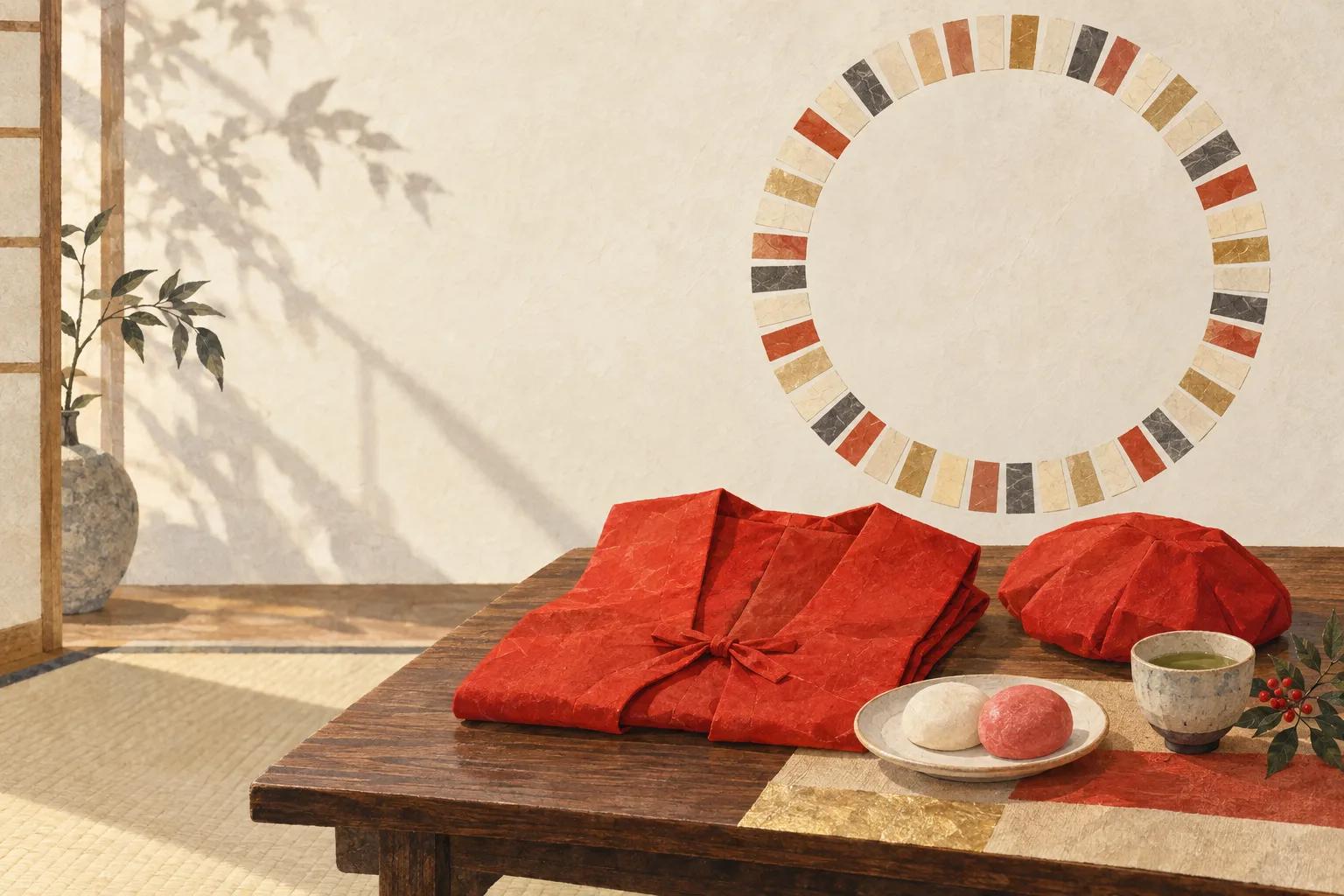
The 60th birthday is special in Japan because it completes the calendar. Japan's traditional calendar names every year with one of 60 signs, the eto (干支), so at 60 the sign of a person's birth year comes round again for the first time. The birthday is called kanreki (還暦), the "return of the calendar", and it's treated as a second birth: the person is traditionally given red clothing as a sign of being born again. For centuries 60 was also the age to hand over the household and step back from work, and it's still the lowest retirement age a Japanese employer may set.
| Question | Answer |
|---|---|
| What is it called? | Kanreki (還暦), "return of the calendar"; also kakō (華甲) and hongaeri (本卦還り) |
| At what age? | The 60th birthday in full years, which is 61 in traditional counting |
| What returns? | The eto of the birth year, one of 60 pairings of a stem and an animal |
| Why red? | A red sleeveless jacket (chanchanko) and hood mark being born again |
| What did it once mean? | Retirement and handing the family headship to the next generation |
| What comes next? | Koki at 70, kiju at 77, sanju at 80, beiju at 88, sotsuju at 90 and hakuju at 99 |
What does kanreki mean?
Kanreki (還暦) joins 還, "to return", and 暦, "calendar". Japanese dictionaries define it as the return, after 60 years, of the eto of the year a person was born, and the celebration of reaching that age (Kotobank, citing the Digital Daijisen, the Nihon Kokugo Daijiten and the Nipponica encyclopedia). Two older names say the same thing. Hongaeri (本卦還り) means going back to one's original sign. Kakō (華甲) is a character puzzle: 華 can be read as six 十 (ten) above one 一, which makes 61 in traditional counting, and 甲, the first stem, as in 甲子, stands for years.
In a card or a speech, "kanreki omedetō gozaimasu" (還暦おめでとうございます), congratulations on your kanreki, is the natural phrase.
Why does the calendar return at 60 and not at 12 or 120?
The eto combine two counters that move forward together, one step each year. The first is the ten heavenly stems (jikkan, 十干): the five elements wood, fire, earth, metal and water, each in an elder form (e) and a younger form (to). The second is the twelve earthly branches (jūnishi, 十二支), the familiar animals from rat to boar. Because both counters advance at once, they arrive back at the same pair only after 60 years, the smallest number that both 10 and 12 divide into.
Ten stems times twelve animals would allow 120 pairs, but half of them never occur. An elder stem only ever meets the rat, tiger, dragon, horse, monkey or dog, and a younger stem only the ox, rabbit, snake, sheep, rooster or boar (National Astronomical Observatory of Japan). The National Diet Library's guide to the Japanese calendar lists all 60 pairs in order, from kinoe-ne (甲子), wood rat, to mizunoto-i (癸亥), water boar.
That is why the zodiac animal returns every 12 years while the full sign returns only at 60. At 12, 24, 36 and 48 the animal comes back with a different element. At 60 the element and the animal match the birth year together for the first time.
The system was devised in ancient China, reached Japan by way of the Korean peninsula and was used in the Japanese calendar from about the reign of Empress Suiko, in the late sixth and early seventh centuries (Nihon Kokugo Daijiten, via Kotobank).
How do you find someone's birth-year sign and kanreki year?
The stem follows the last digit of the Western birth year:
| Last digit of the year | Stem | Reading | Element |
|---|---|---|---|
| 4 | 甲 | kinoe | wood, elder |
| 5 | 乙 | kinoto | wood, younger |
| 6 | 丙 | hinoe | fire, elder |
| 7 | 丁 | hinoto | fire, younger |
| 8 | 戊 | tsuchinoe | earth, elder |
| 9 | 己 | tsuchinoto | earth, younger |
| 0 | 庚 | kanoe | metal, elder |
| 1 | 辛 | kanoto | metal, younger |
| 2 | 壬 | mizunoe | water, elder |
| 3 | 癸 | mizunoto | water, younger |
For the animal, subtract 4 from the year and divide by 12. The remainder counts along the branches: 0 is the rat (子, ne), then ox (丑, ushi), tiger (寅, tora), rabbit (卯, u), dragon (辰, tatsu), snake (巳, mi), horse (午, uma), sheep (未, hitsuji), monkey (申, saru), rooster (酉, tori), dog (戌, inu) and boar (亥, i) at 11. For the place in the 60-year cycle, subtract 3 from the year and divide by 60, where a remainder of 0 means 60. The kanreki year is the birth year plus 60.
These are the people celebrating kanreki now and in the next few years:
| Born | Sign | Reading | Kanreki year |
|---|---|---|---|
| 1964 | 甲辰 | kinoe-tatsu, wood dragon | 2024 |
| 1965 | 乙巳 | kinoto-mi, wood snake | 2025 |
| 1966 | 丙午 | hinoe-uma, fire horse | 2026 |
| 1967 | 丁未 | hinoto-hitsuji, fire sheep | 2027 |
| 1968 | 戊申 | tsuchinoe-saru, earth monkey | 2028 |
| 1969 | 己酉 | tsuchinoto-tori, earth rooster | 2029 |
| 1970 | 庚戌 | kanoe-inu, metal dog | 2030 |
Is kanreki celebrated at 60 or 61?
Both numbers describe the same birthday. Dictionaries give kanreki as age 61 because they use kazoedoshi (数え年), the traditional count in which a baby is one at birth and everyone gains a year at the new year. In full years, which is how ages are stated in Japan today, that is the 60th birthday. A law of 1949, in force from 1 January 1950, asked the public to state ages in full years instead of the traditional count (Act on the Way of Stating Age). Modern references such as the Japanese edition of Britannica describe kanreki as the celebration of the 60th birthday (Kotobank), and that is when most people mark it.
Why do people wear red for kanreki?
Red stands for being born again. The person is traditionally given a red sleeveless jacket (chanchanko) and a red hood to show that the calendar, and their life with it, has started over (Britannica and the Heibonsha World Encyclopedia, via Kotobank).
Local customs add their own touches. The Nipponica encyclopedia records that people in Kanagawa once visited a shrine dressed in red from hood to socks, often on 15 November, the day children visit shrines for Shichi-Go-San, and that families in parts of Kagawa hand out two large rice cakes (same page). A nippon.com overview adds that the red jacket was also meant to ward off evil. Sumo keeps the tradition too: in 2023 stablemaster Hakkaku, the former yokozuna Hokutoumi, performed a kanreki ring-entering ceremony at Ryōgoku Kokugikan wearing a red rope (Nikkei).
For someone who'd rather not wear the jacket, a smaller red gift, such as a scarf or a sweater, keeps the meaning without the costume.
How old is the kanreki tradition?
Birthday celebrations for older people in Japan are far older than kanreki itself. The earliest record is the celebration of Emperor Shōmu's 40th year in 740. These court celebrations, called sanga (算賀), came from China and were held at 40 and every ten years after, with banquets, music and poetry. Even the gifts matched the age: 40 white horses, 40 sutra scrolls and 40 chests for a 40th (Kotobank, 算賀).
The 61st as a celebration in its own right appears from the late Muromachi period, in the fifteenth and sixteenth centuries, alongside 42, 70, 77, 88, 90 and 99 (same entry). It became general in the Edo period, and Japanese encyclopedias class it as an early modern custom, younger than the celebration of 70 (Kotobank, 還暦). Nara-period records therefore show celebrations of 40, 50 and later decades, while the idea of 60 as the calendar's return belongs to a later age.
Why did 60 mark retirement in Japan?
In pre-modern Japan, 60 or 61 was the customary age to retire (inkyo, 隠居) and pass the headship of the family to the next generation, a habit the Heibonsha World Encyclopedia links to the idea of a completed cycle. In old village society, people aged 13 or 15 to 60 could be called up for communal labour, so 60 also marked the end of that duty (Kotobank).
The age survives in law. Article 8 of the Act on Stabilization of Employment of Elderly Persons forbids a mandatory retirement age below 60, a rule in force since 1998 (Kondo and Shigeoka). Employers must also secure work for their staff up to 65, and since April 2021 they must make efforts to do so up to 70 (Ministry of Health, Labour and Welfare).
Most do it by rehiring people after they retire. In the ministry's 2025 survey of 237,739 companies with 21 or more employees, 99.9% had measures to keep people working to 65. Of those, 65.1% used continued employment, 31.0% had raised their retirement age, and 34.9% of all companies set a retirement age of 65 or above or none at all (MHLW). Continued employment usually means retiring at the company's retirement age and signing a new contract, often on lower pay. In 2020, 85.5% of people reaching retirement at companies with a retirement age of 60 were kept on this way, and a 2020 survey found that for employees on average-level wages, pay at 61 was about 79% of pay just before 60 (Japan Institute for Labour Policy and Training).
For many people in Japan, then, a 60th birthday still coincides with a change of role or a farewell at work. If a colleague's kanreki is also their retirement, our guide to making a retirement video covers what to say and how to gather messages from the team.
Why is 2026 a special kanreki year for people born in 1966?
1966 was a hinoe-uma (丙午), or fire horse, year: number 43 of the 60. An old superstition, which settled among city dwellers in the Edo period, held that women born in a fire horse year would bring misfortune to their husbands (Kotobank, 丙午). In 1966 many couples avoided having a child. Japan recorded 1,360,974 births that year, against 1,823,697 in 1965 and 1,935,647 in 1967 (MHLW vital statistics). That is 462,723 fewer births than the year before, a fall of 25.4%.
Sixty years later, 2026 is a fire horse year again. The people born in 1966, a generation about a quarter smaller than the one before it, celebrate kanreki under the same sign that once made their parents' generation hesitate. For them the return of the calendar also closes the story of the superstition that shaped their birth year.
Is 60 still considered old in Japan?
Sixty now marks the middle of a long later life. Japan's 2025 life table gives a 60-year-old man about 24 more years on average and a 60-year-old woman about 29 (MHLW). Life expectancy at birth is 81.35 years for men and 87.33 for women. In 1947 it was 50.06 and 53.96. Those older figures are pulled down by deaths in infancy and childhood, so they understate how long adults lived, and the change is still large.
The Nipponica encyclopedia notes that kanreki celebrations have become less elaborate as lives have lengthened (Kotobank), and a nippon.com overview of longevity celebrations points out that most people turning 60 today are still working. Kanreki now tends to mark the start of the next stage of an active life.
What are the Japanese longevity celebrations after kanreki?
After kanreki come a series of named birthdays, known together as gaju (賀寿) or, in everyday speech, toshiiwai (年祝). Kanreki, koki, kiju and beiju have been the four established celebrations since the early modern period (Britannica, via Kotobank), and most of the names are puns on the shape of a kanji (nippon.com).
| Age | Name | Where the name comes from |
|---|---|---|
| 70 | Koki (古希) | From Du Fu's line 人生七十古来稀: to live to seventy has been rare since ancient times |
| 77 | Kiju (喜寿) | The cursive form of 喜 (㐂) looks like 七十七, 77 |
| 80 | Sanju (傘寿) | The short form of 傘 (仐) looks like 八十, 80 |
| 81 | Hanju (半寿) | 半 splits into 八, 十 and 一: 81 |
| 88 | Beiju (米寿) | 米 splits into 八, 十 and 八: 88 |
| 90 | Sotsuju (卒寿) | The short form of 卒 (卆) looks like 九十, 90 |
| 99 | Hakuju (白寿) | 百 (100) without 一 (1) leaves 白 |
| 100 | Hyakuju (百寿) | 百 means 100 |
| 108 | Chaju (茶寿) | 茶 splits into 十, 十 and 八十八: 20 and 88 |
| 111 | Kōju (皇寿) | 白 (99) above 王, which splits into 十 and 二 (12) |
Okinawa and the Amami Islands follow a different rhythm. There, age celebrations fall whenever the birth-year animal returns: at 13, 25, 37, 49, 61, 73 and 85 in the traditional count. In some regions of the main islands, 13, 25, 37 and 61 are instead yakudoshi, years considered unlucky (Heibonsha World Encyclopedia, via Kotobank).
Is the 60th birthday special in Korea too?
Korea marks the same moment as hwangap (환갑), also called hoegap and hwagap (華甲), the 61st birthday in Korean counting, when the sixty-year cycle returns to the birth sign. The family traditionally lays out a large feast table for the person (Encyclopedia of Korean Culture). The shared name 華甲 reflects the shared cycle, which Japan received from China by way of Korea. Other cultures single out a different age as the turning point; in Latin America it is a girl's 15th birthday, the quinceañera.
How can you celebrate a 60th birthday in the spirit of kanreki?
Kanreki's idea is that the calendar starts again, so the person gets a fresh start. That idea travels well, whether your loved one grew up with the custom or you want to borrow it for a 60th somewhere else. A few ways to honour it:
- Give something red. A chanchanko set suits someone who enjoys tradition and a joke. A red scarf, sweater or wallet suits someone who doesn't.
- Gather the family. Relatives and friends traditionally hold a feast and bring gifts, and in Kagawa it's said that the children are the ones who host.
- Write their sign. Adding the birth-year eto to a card or cake, such as 丙午 for someone born in 1966, ties the day to the cycle it celebrates.
- Ask about what comes next. Invite your loved one to name something they want to begin this year.
If you'd like a gift that treats the new age as an opening, yume's The Legend of You is an epic movie trailer starring your loved one. You add two to four photos, their name, the age they're turning and four to eight things they love, and the trailer builds its scenes around those passions before ending on the title "The Legend of [name], Season 60 begins". That closing line fits kanreki's idea of a new cycle. The trailer runs about a minute, is ready about 15 minutes after you send the details and costs €19 with one edit included, and your loved one doesn't need to do anything. The narration is in English only, and the trailer has no red clothing, eto or Japanese text, so for a parent who doesn't follow English it works best alongside the family celebration. Watch the example on its page to see whether the style suits the person turning 60.